Reviewed by Roy Berko
There is a reconstructed theatre company in the area, none too fragile, which bills itself as “Akron and Northeast Ohio’s home for kick-a** theater!.” It has just opened its second show in its new venue.
Formerly affiliated with Bang and Clatter, Sean Derry and Alanna Romansky have reconstituted the performance company and, after a short tenure in Cuyahoga Falls, has settled into a space in the rear section of Bricco’s restaurant. Derry, who has built no less than six theaters, swears “this is the most permanent and final one.”
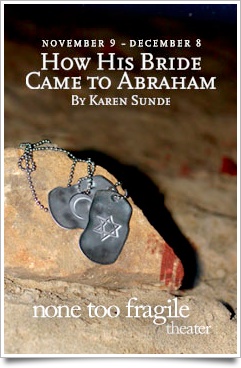
Karen Sunde’s HOW HIS BRIDE CAME TO ABRAHAM is billed as a pacifist tragedy, which is timely and haunting. If you consider a bias toward the Arabic cause to be acceptable, the play fits the definition of “pacifist.”
Sunde sets out to create a modern myth in which a wounded male Israeli soldier (Abraham) and a female Palestinian terrorist (Sabra) find themselves in Southern Lebanon, at night, in a cave-like enclosure. Strong tension and mistrust are present. They spar over homes and rights and threaten each other with death. She tells horror stories about what was done to her family by the Israelis. He tells stories about his grandmother and the Holocaust. Voices and sounds invade their interactions. Eventually, through a series of questionably motivated writing maneuvers, the duo has a sexual liaison. The motivation of how “love” has blossomed between the duo is as illusionary as the premise of pacifism.
Sunde, in an interview, states, “I am a story-teller. Life fascinates me, so I portray it in any form it seems to call for.”
I found the play filled with propaganda, couched in the form of the stories. It is a diatribe of horrors that Israelis committed, with little balance of the history of the Arab inspired attacks against the Zionist state.
As emotionally moving as the play may be, biased views do not a pacifist tale make. If anything, this furthers the cause of hatred.
The play, which was originally published in 2001, and officially premiered in January of 2004, is in the process of being made into a movie sponsored by the IDOC/NORTH AMERICA. The organization “deals with contemporary and recent historical issues that relate, on a perspective from the individual to the global, to the concerns of opinion-makers and public policy-making groups in the United States, and, where possible, abroad.” They propose that “The Abraham Project is intended to highlight the need to reconcile Israelis and Palestinians, and to dissolve the death-grip in which each is held by the other.”
Though that mission is noble, HOW HIS BRIDGE CAME TO ABRAHAM is not the kind of vehicle to develop that goal. It is too biased, not well written, and too unclear in objective purpose.
The none too fragile production, under the direction of Sean Derry is often compelling. Performed in a sand covered area, dust flies, conflict is evident, the acting good.
Both Gabriel Riazi and Leighann Niles Delorenzo form meaningful characters, stretching beyond the limits of the script. In spite of their excellent acting, the overall supposed message is missing. Nowhere do we get what the author says is her purpose, “a distinct work that will help, and will answer ‘What can I do?’ in a world and a time that needs all of our best efforts.” The author further states that she set out on a mission, “So they [the audience] could leave that space with new hope, new compassion, and a fresh determination to resolve their peoples’ conflict.” Again, where she perceives this in her script is a mystery.
Capsule judgement: In spite of good acting and an intense production, HOW HIS BRIDE CAME TO ABRAHAM has such a biased development that it fails to live up to the stated goal of educating the audience on hope and compassion as it relates to a pacifist attitude toward the Israeli/Arab conflict.
 From Cool Cleveland contributor Roy Berko. Berko’s blog, which contains theatre and dance reviews from 2001 through 2012, as well as his consulting and publications information, can be found at http://RoyBerko.info. His reviews can also be found on NeOHIOpal and CoolCleveland.com.
Roy Berko, who is a life-long Clevelander, is a Renaissance man. Believing the line in Robert Frost’s poem “Road Not Taken,” each time he comes to a fork in the road, he has taken the path less traveled. He holds degrees, thought the doctorate from Kent State, University of Michigan and The Pennsylvania State University. His present roles, besides husband and grandfather, are professor, crisis counselor, author and entertainment reviewer… Read Roy Berko’s complete bio here