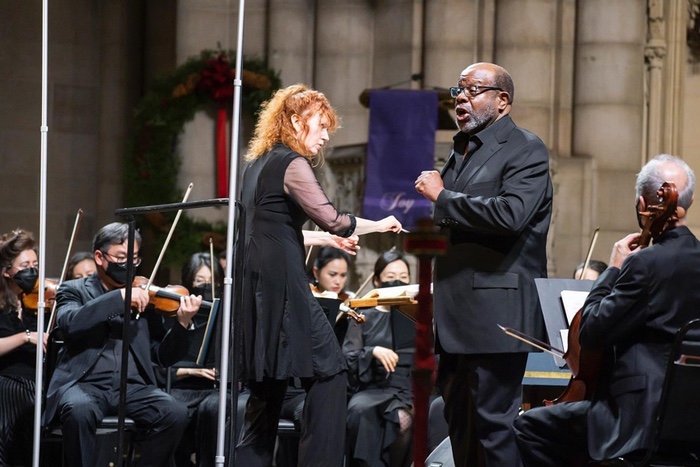
Apollo’s Fire, conducted by Jeannette Sorrell, filled the Severance Music Center’s main stage on November 8 with an original and engaging program titled “Mozart’s Requiem: A Tapestry: A Masterpiece Reimagined.” The concert’s blend of Mozart’s Requiem (1791), newly commissioned music, and traditional spirituals wove old and new into a coherent whole and created a magical evening.
The Requiem, famously left incomplete by the dying 35-year-old genius, has been “completed” by composers over the centuries, but (as Sorrell pointed out in program notes) their additions lack something—Mozart’s voice. Sorrell chose to present a concert combining the parts we know Mozart wrote (38 minutes’ worth) with pieces that complemented and/or enhanced what she believes reflected his world (as tumultuous as our own) the composer lived in. She threaded them into what she describes as a “Tapestry of our Time.”
The six-sectioned program wove multiple elements into each division. As an example, the opening segment “REMEMBER THEM,” moved from the “Introitus” from Mozart’s Requiem in D minor, to Sorrell’s “Voices of 1791” (those voices are from enslaved people sailing from the west coast of Africa) and finished with Mozart’s “Kyrie eleison. Christe eleison.”
Following that came sections labeled MOTHERLESS CHILD, THE KING OF GLORY, ON THE PRECIPICE, DELIVER US FROM EVIL, and WE’LL HEAR THE SAINTS A-SINGING. Compositions interspersing Mozart’s composition were Damien Geter’s “An African American Requiem,” the world premiere of Eric Gould’s “1791: Requiem for the Ancestors,” Jessie Montgomery’s “Five Freedom Songs,” and Sorrell’s “Voices of 1791.”
Guest soloists Sonya Headlam (soprano), Guadalupe Paz (mezzo-soprano), Jacob Perry (tenor), and Kevin Deas (bass-baritone), plus two Apollo’s Singers (sopranos Elora Kares and base-baritone Charles Wesley Evans broke our hearts and healed our souls with their (seemingly) effortless ability to convey both notes and feelings as they sang.
A full Apollo’s Fire Orchestra and the Apollo’s Singers followed their red-haired genius conductor with enthusiastic conviction. Sorrell’s fitted jacket evoked images of 18th-century composers such as Mozart or Vivaldi.
The large and enthusiastic audience (many of whom admitted to being “first-timers”) responded with delight. The mix of classical, centuries-old compositions, with spirituals and freshly-composed works proved delightful — offering a taste of one genre or another and then moving on quickly to the next. (So, if one didn’t please you, surely the next one did.)
Bottom line: Apollo’s Fire continues to surprise and delight. I think Mozart would have approved hearing baroque-era instruments and classic works presented alongside new pieces. As is all too easy to say (so I will again say it) “Apollo’s Fire still burns bright.”
Side note: This blend of old and new, bringing out the similarities between eras (with a tasteful reproach to current politics) did indeed resemble a tapestry. It also suggested quilts, such as those from African-American artists in Alabama’s Gees Bend with its mix of traditional and “right now.”