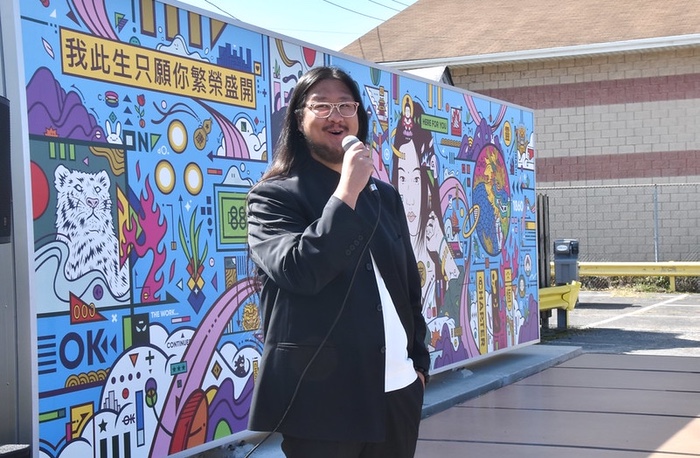
Last month, CoolCleveland made a public records request to review all documents, receipts, and payment records made concerning the Transformative Public Art Projects Fund Program (TAF) to understand how the funded projects have benefited the city’s neighborhoods as intended in the original legislation and how many Cleveland artists actually benefited from the $3 million American Rescue Plan Act (ARPA) federal stimulus package that funded the project.
Officials assigned a reference number to a public records request made on February 20 and are currently reviewing it. As of this publication deadline, they have released no records.
Jeremy Johnson, president and CEO of Assembly for the Arts, fiscal agents for the project, said in an email that “inquiries related to TAF should be directed to the city of Cleveland.” Rhonda K. Brown, City of Cleveland senior advisor for arts and culture, has not responded to a request for comment.
When asked to review quarterly reports from the artist, as the city’s agreement required, and whether the city’s TAF funds paid Assembly for the Arts, their fiscal agent, Johnson responded, “All of our information goes to the city.”
TAF’s grant recipients did not respond to our emails or phone messages requesting an interview. Unconfirmed reports suggested artists were required to sign a non-disclosure agreement (NDA).
Apparently, no one is talking.
Several years ago, CoolCleveland reported that local artists mobilized, holding community meetings and calling their city representatives. The city, under the Office of the Mayor, received the $3 million as a result of community efforts and activism.
City Council President Blaine Griffin and Mayor Bibb drafted the emergency legislation (Ordinance 895-2022 and amendments) in late 2022, which passed unanimously by the city council in October of that same year.
ARPA funds, through the TAF program, were designed to support public art in neighborhoods with high BIPOC (Black, Indigenous, and People of Color) populations and provide grants to community development corporations, nonprofit organizations, and other public and private entities for publicly accessible art programs.
An executive summary of the legislation noted that recovery funds were intended to encourage capital investments in neighborhoods with arts deserts through large-scale public art installations and landmark arts facilities, focusing on areas with high BIPOC populations that either lacked arts investment or risked cultural displacement.”
Eight months later, Brown was hired by the city as its first senior strategist for arts, culture, and the creative economy. The Cleveland Foundation funded her position with a two-year $250,000 grant. In a previous interview with CoolCleveland, she was asked whether the TAF project was presented to her during the interview, and Brown replied, “No.”
A special program arts committee was created to review proposals and make recommendations, which included Gina Washington, Susie Underwood (who later stepped down), and William Washington, chosen by Mayor Bibb; Vince Robinson, Letitia Lopez, and Gwen Garth, selected by Council President Blaine Griffin; Maya Curtis from Cuyahoga Arts and Culture; and Deidre McPherson from the Assembly for the Arts.
Following just three months of deliberation, the City of Cleveland announced seven recipients from a pool of 103 applications, awarding nearly $3 million for community-driven public art projects. The artists receiving funding included Malena Grigoli ($364,000), LaTecia Delores Wilson Stone ($312,185), Jordan Wong ($449,750), Ariel Vergez ($393,700), Jameelah Rahman ($482,125), Robin Robinson ($393,397), and Kumar Arora ($465,343).
Awards totaled $2,860,500, with an additional unconfirmed $90,000 to the Assembly for the Arts as the fiscal agent (Johnson did not confirm or deny the payment). The numbers do not exactly match up; without public records, there is no way to account for this discrepancy.
“These artist-led projects are not simply public artworks—they are transformative forces, designed to spark connection, inspire dialogue, and cultivate a more inclusive, vibrant city,” according to a post on the city’s website by Brown, but questions surrounding the $3 million project to provide transformative experiences in Cleveland’s neighborhoods remain unanswered.
Kumar Arora, for example, listed his partnership neighborhoods as Hough, Campus District, Downtown, and University Circle. His culminating project took place at Jacobs Pavilion on the West Bank of the Flats, far from any of these neighborhoods. Another of his projects was also in the Cleveland Flats. During a public presentation at the MLK Library, Arora told the audience that his project would pay 137 individual artists. Without a budget breakdown, we don’t know how much each was paid.
Aurora described the project, the I’m From Cleveland Arts & Music Festival, held on September 6, 2025, as a “transformative force.” However, the question remains: how did this project specifically affect the West Bank of the Flats, an area surrounded by luxury apartments and a high-end events venue?

Malena Grigoli’s project included workshops that explained “mycotecture,” or the use of fungal organisms to shape the built environment, and an artistic installation on the park-like site, indicative of the house’s transformation. Whether the project provided the neighborhood with a place for rest remains uncertain.
Jordon Wong described his installation as an artful light box to bring more light to the outdoor eating areas in the former parking lot of Dave’s Supermarket on Payne Avenue in Cleveland’s AsiaTown. The project included ornamental planters, three outdoor ping-pong tables, die-cut steel nets, vinyl artwork, and graphics. It is unclear whether the community actually uses the park or what public programs are planned for the future.
Without the city promoting the long-term transformative impact of these projects through photographs, data, and interviews with the artists and community, artists promote themselves with varying degrees of success. The general public remains unaware and uninformed.
Unfortunately, the lack of public records raises more questions than answers about the use of public money as economic relief to artists in Cleveland. Without documentation, we don’t know how many people, let alone artists, received funding.
“This is a proud moment for the City of Cleveland, as this is the first time in our city’s history where we have established a foundation for artists, institutions, and communities to find hope in creativity,” said Mayor Bibb in a press release in July 2024.
Talk to us. Release the records. Show us how proud you are.